
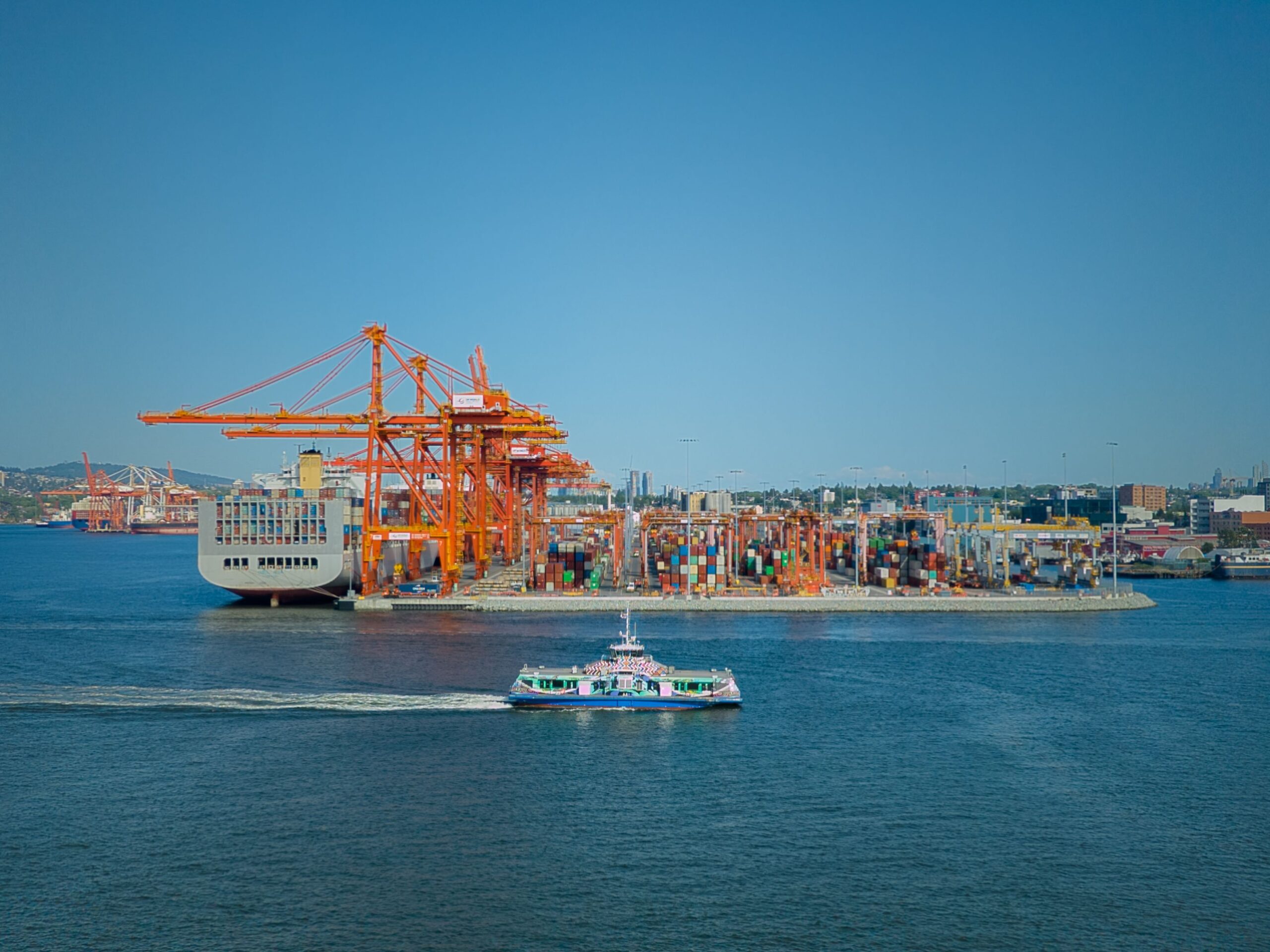
Vancouver and Germany may sit nearly 8,000 kilometres apart, but the ties between them have never felt closer. From the busy docks of the Port of Vancouver to the research labs at UBC, and from new German investment dollars flowing into BC’s life sciences sector to the direct flights connecting the two regions, a quiet but steady partnership has been building across nearly every sector of public life — trade, research, industry, and infrastructure. As Canada looks to diversify its international relationships and Germany looks for reliable partners in a shifting global economy, British Columbia is emerging as one of the country’s most active points of connection. Here are six recent examples that show just how far that relationship has come — and where you can go to learn more or get involved.
1. Port of Vancouver and Port of Hamburg Team Up on Sustainability
In one of the more significant institutional partnerships of the past two years, the Hamburg Port Authority and the Vancouver Fraser Port Authority signed a memorandum of understanding on November 7, 2024, committing to deeper cooperation on maritime decarbonization, safety, digital innovation, and cruise operations. The Port of Hamburg is Germany’s largest seaport and Europe’s third largest, as well as Europe’s biggest rail port, while the Port of Vancouver is Canada’s largest and most diversified port, moving roughly $300 billion in trade every year across its 29 terminals. Planned joint work includes exploring alternative fuel bunkering, testing drone-based safety technology, and building shared cybersecurity practices — plus staff exchanges so employees at each port can learn from their counterparts overseas.
🔗 Read the full release — Vancouver Fraser Port Authority
As found on: Vancouver Fraser Port Authority
2. UBC’s Research Alliance with Germany’s Top Scientific Institutions
The University of British Columbia holds formal research partnerships with three of Germany’s most prestigious scientific organizations: the Fraunhofer Society, the Helmholtz Association (home to the German Aerospace Centre, DLR), and the Max Planck Society. The Max Planck–UBC Centre for Quantum Materials, established in 2010, was only the third Max Planck Centre ever created outside Germany, and its 2021 renewal marked the first time an international Max Planck Centre had ever been extended past the standard ten-year term. The relationship reached a symbolic high point in 2023, when German President Frank-Walter Steinmeier visited UBC’s Vancouver campus as part of his first official trip to Canada, and when the UBC Symphony Orchestra toured Germany alongside Stuttgart’s Academic Orchestra that same year.
🔗 Read more — UBC Office of Global Engagement
As found on: UBC Office of Global Engagement
3. Evonik’s $108.3 Million Bet on Vancouver’s Life Sciences Sector
German specialty chemicals company Evonik announced plans this past summer to build a new GMP drug product manufacturing facility in Vancouver, supporting the production of vaccines, therapeutics, and other advanced medicines, with production targeted to begin by the end of 2029. BC’s Minister of Jobs and Economic Growth, Adrian Dix, connected the investment to the province’s “Look West” strategy — a ten-year plan to double jobs in BC’s life sciences sector to 40,000 and grow its economic footprint by 75%. It’s a strong signal that German industry sees Vancouver not just as a trading partner, but as a place to plant roots.
🔗 Read the announcement — Area Development
As found on: Area Development
4. German Manufacturers Bring Their Technology to SFU
On June 3, 2026, the Mechanical Contractors Association of BC (MCABC) partnered with the Canadian German Chamber of Industry and Commerce to host a delegation of German building-technology manufacturers at SFU’s Vancouver campus. Funded by the German Federal Ministry for Economic Affairs and Energy, the event connected six German companies directly with BC’s mechanical contracting and construction industries, giving local firms early access to European advances in energy-efficient building technology.
🔗 Read the coverage — Journal of Commerce
As found on: Journal of Commerce (ConstructConnect)
5. Direct Flights Keep the Two Regions Connected
None of this would be nearly as easy without the physical links that make travel between the two regions possible. Vancouver–Frankfurt is served non-stop by Air Canada, Condor, and Lufthansa, while Vancouver–Munich is served non-stop by Lufthansa — giving British Columbians, and the region’s German-speaking diaspora, direct access to two of Germany’s largest economic hubs. These routes are more than a travel convenience; they’re the connective tissue that makes business trips, academic exchanges, and family visits possible without a layover.
🔗 Check current schedules — Lufthansa
As found on: Lufthansa
6. Northern BC’s Landmark LNG Deal with Germany
Stretching the story a little further north, the Ksi Lisims LNG project in northern British Columbia moved closer to a major milestone in May 2026, when a landmark offtake agreement with German energy company SEFE was expected to be announced. Canada’s federal International Trade Minister, Maninder Sidhu, framed the deal as part of Canada’s push to be seen as a reliable, trusted energy partner as European natural gas prices climbed. While the project itself sits outside Metro Vancouver, its ripple effects — investment, jobs, and diplomatic goodwill — extend across the whole province, reinforcing BC’s role as a gateway for Canada-Europe energy trade.
🔗 Read the report — CBC News
As found on: CBC News
A Relationship Built on More Than Trade
Taken together, these six stories paint a picture of a relationship that has moved well beyond ceremonial gestures. Ports are sharing technology, universities are co-funding decade-long research centres, German companies are putting real capital into BC’s economy, and the everyday infrastructure — flights, trade delegations, energy deals — keeps getting stronger. For Vancouver’s German-speaking community, and for anyone watching Canada’s efforts to diversify its economic and diplomatic relationships beyond its southern neighbour, this is a partnership worth watching closely in the months ahead.
Stay tuned — a follow-up article is coming soon looking at the benefits of Canada potentially becoming an Associate Partner of the EU, and what that could mean for businesses and communities right here in Vancouver.
TAGS: #CanadaGermany #VancouverGermany #GermanCanadianBusiness #BCEconomy #WestcoastGermanNews #EUCanadaRelations