
2030 World Cup: Three Continents Six Countries
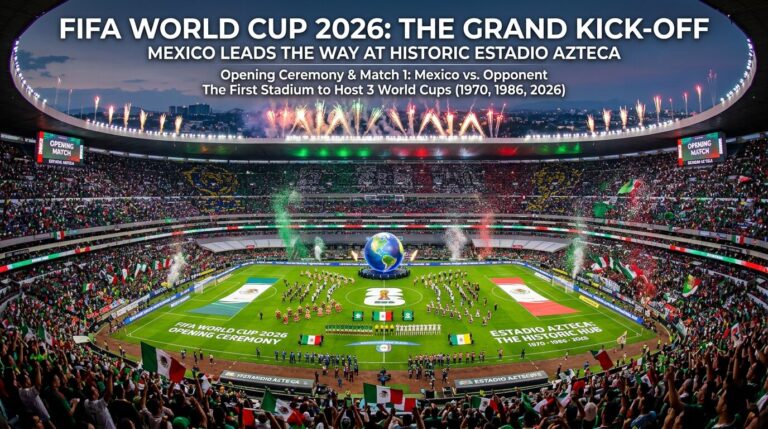
With the confetti barely swept up from the 2026 tournament across the United States, Canada, and Mexico, football’s attention is already turning to 2030 — and by most accounts, it will be the most ambitious World Cup ever staged.
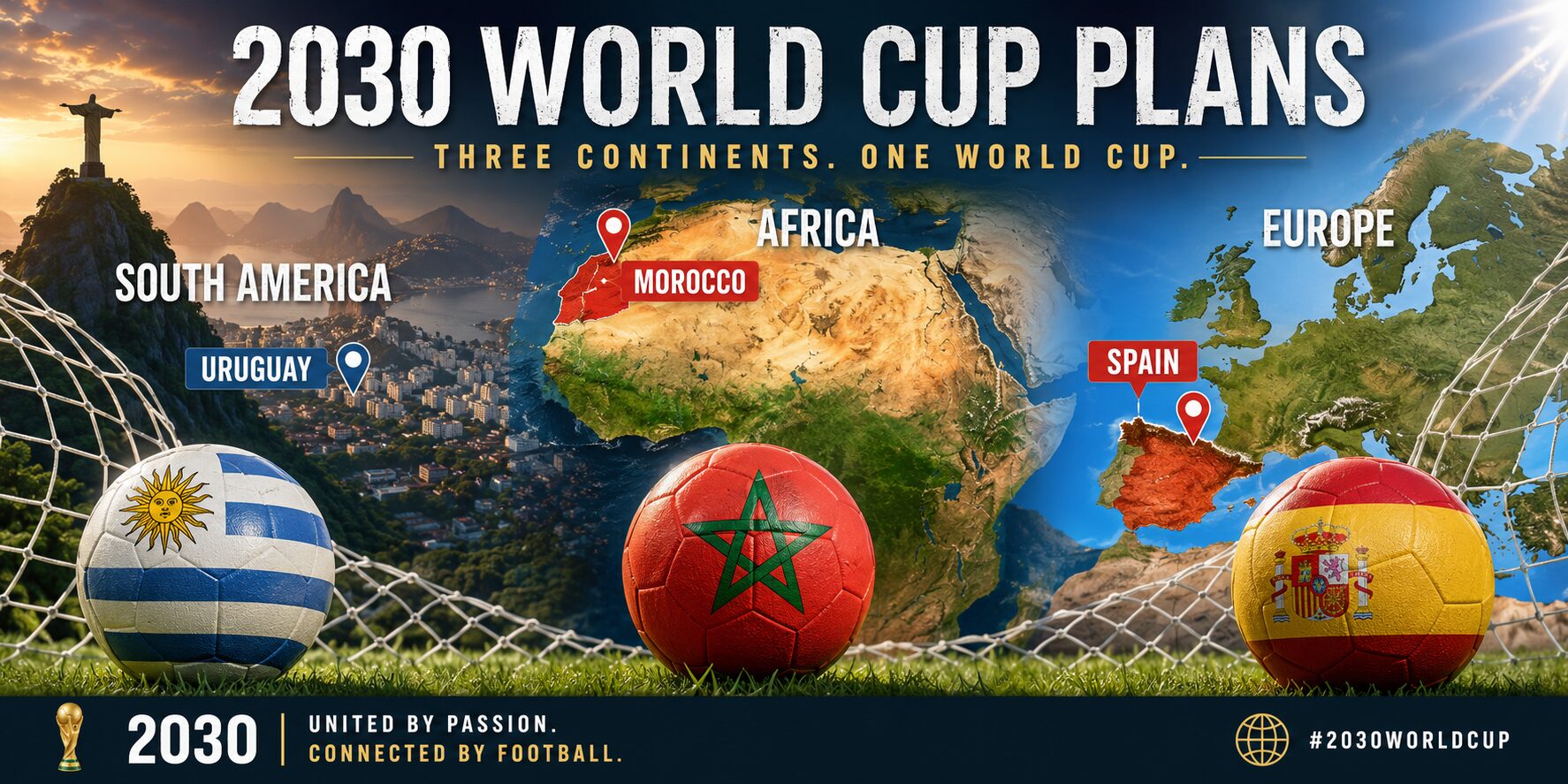
Three continents, six countries
The 2030 FIFA World Cup will be jointly hosted by Spain, Portugal, and Morocco, making it the first World Cup ever played across two continents at once — Europe and Africa — in a single edition. But the story doesn’t stop there. To mark the tournament’s 100th anniversary, FIFA is adding a symbolic twist: three opening matches will be played in South America, one each in Uruguay, Argentina, and Paraguay, honouring Uruguay’s role as host of the very first World Cup in 1930.
That brings the true host count to six nations across three continents — Europe, Africa, and South America — a scale no previous World Cup has come close to matching.
Roughly 18 cities, not a handful
While Morocco’s share of the tournament will be centred on six cities — Casablanca, Rabat, Marrakesh, Agadir, Fez, and Tangier — that’s only one piece of the map. Portugal will host matches in Lisbon and Porto, while Spain spreads the tournament across nine cities: Madrid, Barcelona, Seville, Bilbao, San Sebastián, Zaragoza, Las Palmas, Valencia, and Vigo. Add in the three South American cities hosting the centenary matches, and the 2030 World Cup is expected to unfold across roughly 21 stadiums in 18 cities — though FIFA won’t formally confirm the final list until December 2026.
48 teams confirmed — 64 still a live question
For now, FIFA is expected to stick with the 48-team format that debuted at the 2026 tournament. But there’s a real push to go even bigger: FIFA president Gianni Infantino has floated expanding to 64 teams, and CONMEBOL president Alejandro Domínguez recently stated publicly that the 2030 tournament would feature 64 teams. That claim hasn’t been confirmed by FIFA, so for now it remains an ambition rather than a done deal — one that would push the tournament past 30 percent of all FIFA member associations taking part.
The longest World Cup yet
Regardless of the final team count, 2030 is already set to be the longest World Cup in history: 44 days, running from June 8 to July 21, 2030 — nearly a week longer than the 39-day 2026 tournament. The centenary matches in Montevideo, Buenos Aires, and Asunción will kick things off on June 8 and 9, with the main tournament’s opening ceremony following on June 13–14 in Morocco, Portugal, or Spain.
Between the centenary tribute to 1930, the leap across two continents, and the possibility of a 64-team field, the 2030 World Cup isn’t just bigger — it’s shaping up to be football’s most sprawling celebration yet.
Elke Porter
+1 604 828-8788
elke@westcoastgermanmedia.com
TAGS: WorldCup2030 #FIFAWorldCup #MoroccoSpainPortugal #FootballHistory #WorldCup100 #Fussball2030
About The Author