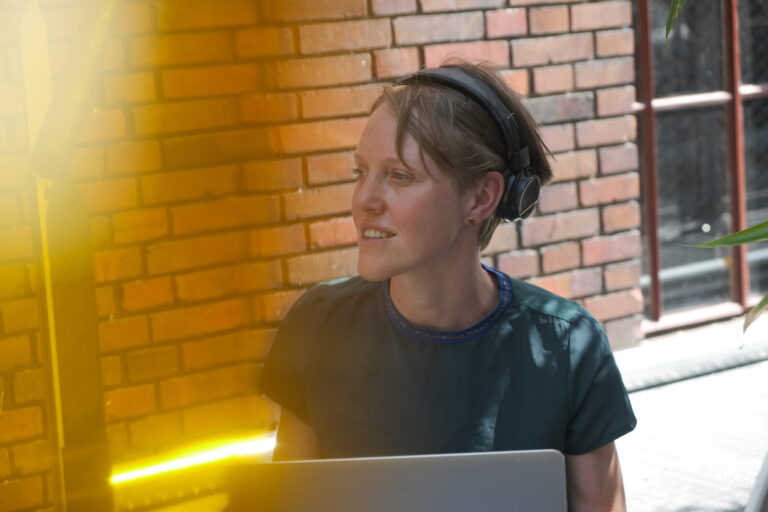


Vancouver/Köln on Zoom – Swiss-born documentary filmmaker Luzia Schmid, now based in Cologne, Germany, discusses her transition from news journalism to filmmaking, her acclaimed works including “Drei Frauen im Krieg” (Three Women at War) and “Hildegard,” and her personal exploration of tax havens in “Ost of Demisitze.” In this wide-ranging conversation, Schmid reflects on the intersection of personal and political storytelling, the challenges facing independent media, and her approach to documentary ethics.
On Career Beginnings and the Shift from Journalism
How did your journalism career influence your film-making, and how do these two practices inform each other?
I started as a news journalist, and I think it’s a very individual approach in my biography. At the time when I started to think I might want to change my ways of working, I realized that news journalism is very conflict-oriented. You need a story, so therefore you need a conflict. I figured out why I was putting so much energy into something that’s very exhausting and demanding, but not solution-oriented.
I’ve always been more interested in the grey shades of subjects, of questions of life. But still, my background as a news journalist is very helpful in my work now because I learned journalism from the ground up, really from scratch. It gives me a feeling of standing on solid ground when it comes to research.
When did your desire to tell stories first emerge?
It really just came up later in life. All of us—I have three siblings—and including my mother, we were all crazy about reading. My father was too busy to read, unfortunately. We didn’t have a television for quite a long time. Since I was the youngest, and older siblings aren’t really keen on always spending time with their younger sibling, reading became a good friend. Maybe that formed my interest in wanting to tell stories, but the desire to do it myself came quite later on.
Living Between Cultures: Switzerland and Germany
How has living in Cologne affected your perspective as a filmmaker rooted in Swiss culture? What influences do you encounter in Germany that you might not have in Switzerland?
I think there are many aspects. First, it’s the experience of leaving home. Switzerland and Germany, from a cultural aspect, one would say they’re not that wide apart, but they are, in fact. It was a very healthy experience to leave your home country in order to understand what it means for other people to leave their home country—whether they liked it or not, whether they had a strong urge, or why they had to leave. For me, it was for educational reasons.
This really gave me new thinking about my own country, about what it means to have a home, what is actually Heimat—I don’t even know if there’s an appropriate English word for Heimat. It’s a very specific term. This resonating about what actually is Heimat, and what it means to people if they have to leave it for whatever reasons, is still with me.
In Germany, the aftermath of World War II is still very present to me because I didn’t grow up in cities that were destroyed during the war—we don’t have that in Switzerland. In Germany, I still haven’t gotten used to the fact that there are not as many old houses as there should be. This immense destruction that just five years of war brought over Germany—I find this constant reminder of the horrors of war disturbing, fascinating, interesting, and humbling, all at once.
Filmmaking Process and Subject Selection
Your films often explore significant social, political, or historical topics. What draws you toward a particular subject? What makes you say, “This is the story I have to tell”?
It’s different for each project. With “Der Ast auf dem ich sitze – Ein Steuerparadies in der Schweiz,” it was obviously my family’s history—my experience of growing up in a small, sleepy hometown that eventually becomes an international hotspot for trading raw materials like oil. That was a very crazy experience, seeing how this very sleepy town suddenly became a bustling international hotspot with questionable practices. My father is a lawyer with expertise in tax law, so that was a very personal approach.
The main question was: I know these people, they’re not bad people, but I just don’t agree with them. So I wanted to find out what drives them, why they feel different than I do.
With “Three Women in the War,” I read articles by Martha Gellhorn and Lee Miller, and I was immediately intrigued. I realized I’d be interested to see this very American but very female perspective on that liberation war. In Germany or Europe, we’re very accustomed to either a male perspective or a very European perspective, but there I saw a new angle.
Do you start with a political question and seek the human element, or is it the human element first?
I think it’s more the human element than the question. I’m intrigued by my personal interest, and I’m always very much interested in motivations of people—why are they behaving the way they do? This is a very personal question, and then I try to make it political in the sense of how our opinions and our values are formed in society, not political in terms of parties.
Ethical Considerations and Representation
Film-making involves ethical decisions about representation, access, and voice. How do you navigate those?
I try to follow my sense of what is appropriate. With Hildegard Knef, she’d been such a public figure, and sometimes I was repulsed by how open she would be about her private life, yet fascinated by this. My ethical guideline was: I do not want to explore her even more. I want to keep a certain distance, I don’t want to be more tabloid than her life has already been.
I wanted to reveal what I think is important to know about her in order to understand this lady, but I didn’t want to sugarcoat her or make a hero’s portrait. I was searching for the lady behind the tabloid and behind the big successes.
What does “respectful distance” mean in practical terms during film-making?
Making a film is all about making decisions—which turn do you take, what footage do you use. It’s really the sum of what you decide for. In my conversation with Hildegard Knef’s daughter Christina “Tina” about her mother’s drug addiction, when Tina said, “Yes, I was there. It wasn’t good. I don’t want to talk about it”—that’s the point where I would never push her to go further, because I think it says it all. Why would I want to know anecdotes and details of how terrible it was? I have a very good imagination, and I’m sure everybody has.
Specific Projects
How did you choose the three war correspondents for “Drei Frauen im Krieg,” and what surprised you most?
The subject was actually proposed to me through an article by a U.S. historian teaching at the University of Zurich who brought these three women—Margaret Bourke-White, Lee Miller, and Martha Gellhorn—together. From day one, I said yes to the movie, but I only wanted to use their own voices, not historians’ commentary.
What I found out was that each of these three women had a very unique, personal approach to war and why she wanted to be a war correspondent. Margaret Bourke-White would only participate once her own country was attacked. Martha Gellhorn was a strong believer in saying we need to fight this war—it’s about us already. Lee Miller was in the war from the first time due to her life circumstances, living in London.
I find these thoughts and ideas very up-to-date. We have similar conversations about the war in Ukraine—when would we go and participate in a war?
What challenges did you face with “Ast auf dem ich Sitze” in conveying complex economic and legal matters?
I hated it because the research was so hard. My brain is not made for this kind of law, and I was being very diligent—it took me months and months. But I realized if I don’t do this properly, I will never understand, and I will always end up being the little girl in our family who doesn’t know what to answer.
The motivation was very strong, to come out of my little girl role and be a partner in conversation. At the end, it drew me closer to my sister, who’s very pro these politics in the film. I still don’t agree with her, but I got a sense of what drives her. I wanted to have a very balanced approach since I have this insight into these people whom others write about—I wanted to share this insight with a broader audience.
Style and Technique
What role do sound, music, and visual style play in your documentaries?
It’s very project-specific. I’m not a dogma person—I do have music in my documentaries. Music is very tricky to work with. I hate those movies where they go for the whole symphonic orchestra supporting every movement with big music. I think that’s wrong—you rather destroy something than bring something to life.
When it comes to music, I try to be supportive but subtle. I rather have people talking. I’m not so keen on expert interviews right now, but maybe it’s just the phase I’m going through. Since we need more experts to be heard in life, more than ever, I might go back to that.
Industry Challenges and Reflections
As a woman in documentary film, have you faced specific barriers?
I was lucky that I started my professional career as a news journalist in the 1990s in Switzerland, where there were many very supporting women helping us younger women. They had the experience of how hard it was as a woman to be heard, to step up, to get chances. I was in that lucky time window where I felt I was harvesting from what the women before me had fought so hard for.
For me personally, I can’t say it was tougher than for men, except for pay, obviously. We have a movement here in Germany called Pro Quota, applying for equal share of funding because we are as many women leaving film schools, but a lot fewer women are actually working in the field.
What’s the biggest shift you’ve seen in funding, distribution, and technology?
Technology, obviously—when I started, we had videotapes and record-play editing. With digital cameras, documentary film-making changed a lot. With AI, I’m skeptical. We have to deal with it, but at the end of the day, this will be a matter of responsibility from all sides—filmmakers and audiences.
In terms of funding, keep your funding systems by all means. Looking at what’s happening in the U.S.—public television shows being cut—this is dangerous. We need independent journalism, be it radio, film-making, whatever art form you choose. It needs to be independent, and therefore you need money.
Impact and Success
What do you hope audiences take away from your films?
Yes, or else I wouldn’t do it. I’ve never been the kind of filmmaker who thinks I’d just do it for myself. I consider myself as an artist, yes, but also as a working person. I’m like a baker—I don’t want my breads to be stone-hard and thrown away.
When I was young and enthusiastic, I thought journalism can change the world. I stopped believing in that. But I still think if it has an impact on people, if it resonates in a different way—I’m not trying to say I’m right with my points of view, not at all. It’s an offer for people to look at it and make their own thoughts. If I should be able to broaden horizons and change the angle of perspective, then I would be very happy.
How do you measure success?
With “Ast auf dem ich sitze,” I was going for a walk after the film was released in cinema in Zug, and we met a couple who knew my sister. They said they were just talking about the film. One was a lawyer for economics law, and she was the daughter of a wealthy private banker—really, the kind of people I was addressing in my work. They were discussing the movie. I thought, “Great! It left the bubble.” I was grateful—whatever it did to them, they saw it and were discussing it. In terms of success, I consider this huge success.
Prizes are very helpful for yourself psychologically. If you work in this line of work, I am always doubtful about my work—is it the right approach, am I good enough? This is crucial for this kind of work. If you really want to be good at something, you need to doubt yourself. When you get positive feedback, it really strengthens and enforces you, especially when it becomes dark and doubtful.
Looking Forward
Are there topics you haven’t yet tackled but feel drawn to in the future?
Yes, but I can’t talk about it. I’m highly superstitious—I feel if I talk about it right now, I will never be able to do it. But there are projects, yes.
Right now, I’m working on a project, but we don’t have funding yet. I do have a vague idea of another project that would start in late 2027 with concrete research. Usually I don’t plan so far ahead, but I’m applying for a fund, so I had to think ahead—something I really need to start doing. Usually I end up with the film finished and no new project, thinking, “Oh fuck, what am I doing next?” Once I work on a project, it’s all over me, so I can’t really have an open mind for thinking ahead.
Luzia Schmid’s films have been featured in international festivals including Berlin International Film Festival (Berlinale), with screenings in Australia, South Korea, and North America. Her work continues to explore the intersection of personal narrative and broader social questions, maintaining what she calls a “respectful distance” while seeking to understand the motivations behind human behavior in complex political and social contexts.
How to Purchase Tickets for “I Want It All. Hildegard Knef”:
- Main ticketing: Visit viff.org for complete festival programming and ticket purchasing
- Indigenous & Community Access: Special ticket options available at VIFF Ticket Info
- Accessibility: Community Access Tickets and Ticket Donation Requests available through the same link
The film is having its North American Premiere at VIFF 2025, presented in German and English with English subtitles.
About The Author