
©Penelope Edgar
An interview with Vancouver artist Brigitte Potter-Mael about her nature-inspired work, oak leaf alphabet, and upcoming exhibitions
Elke Porter: Hello Brigitte! Thank you so much for joining me today. I’d love to start by learning about your journey. When did you come to Canada, and how did you get into art?
Brigitte Potter-Mael: I came to Canada in 1977 by marriage and landed in Montreal with my supportive former husband, Edward Potter-Mael. He was a wonderful human being who encouraged me to follow my dreams and stood by me as I transitioned into the arts—a gesture I still honour by carrying his name. I always wanted to study art but wasn’t sure whether it would be applied arts or fine arts, so I began at the Visual Arts Centre in Montreal, where I completed a diploma in applied arts, weaving, and ceramics. In my second year, my teachers told me that I definitely belonged in university-level fine arts and helped me prepare a portfolio. I entered Concordia University in 1979 and graduated in 1983 with specializations in drawing and printmaking.
Elke Porter: What brought you to the West Coast?
Brigitte Potter-Mael: I first moved to Victoria from Montreal in 1990, but I found that I was lacking access to a printmaking studio. That’s what brought me to Vancouver in 1996, and I became a member of the Malaspina Printmakers Society, where I have been working ever since.
Elke Porter: Your work often connects nature and language. Can you tell me about that?
Brigitte Potter-Mael: In 1999, I had my first show in Germany, in Dresden at Galerie Drei. That brought me in touch with GEDOK Brandenburg, and I became a member in the year 2000. They gave me a solo show called “Zwischen Himmel und Erde” (Between Heaven and Earth). I was firmly grounded in botany and everything that had to do with protecting nature.
I was inspired by the Early Romantic poet-philosopher Johann Christian Friedrich Hölderlin and his whole focus on human-nature relationship. In addition, I was also influenced by the German conceptual artist Joseph Beuys and his idea of art being a tool for “Social Sculpture”. Drawing on these resources to create a forum from which to speak about human-relation to/with nature became my main drive.
In 2000, I also started a meditation practice, and language came into my work. I speak French, German, English, and some Italian, and I felt very conscious that what defines humanity is language.
Elke Porter: I understand you created your own alphabet from oak leaves. How did that come about?
Brigitte Potter-Mael: This is a beautiful story! In 2006, I was in Italy at my studio. There was a big storm, and a branch had fallen off an oak tree. I took it into my studio and laid out the leaves on my table, and it said, “I am an alphabet.” I literally had a rush going through my body. I realized, this is inspiration. I ascribed the German alphabet to 29 oak leaves. Now I had an alphabet, so I had to write with it.
I decided to translate Hölderlin texts into my alphabet. I was reading everything about Friedrich Hölderlin, the early Romantic poet-philosopher, and he became my muse, thanks to his philosophy of interconnectedness between human and nature. But I was insecure about it, so I put it on the shelf until two years ago when I pulled out some prints I had done from carved plates in my alphabet. The public was so fascinated! So I got going, and I looked whether Hölderlin had written anything about oak trees. For sure, he wrote “Die Eichenbäume.” I translated that poem into my oak leaf alphabet. That was the beginning.
Elke Porter: You also worked with a German botanist on a major project?
Brigitte Potter-Mael: Yes! I approached botanist Dr Hermann Muhle, emeritus, University of Ulm in 2009. I said, “I am documenting wild herbaceous plants, and I need to work with a botanist because I don’t have the language.”
He was retiring, which was perfect because now he had time. He collected 174 plants, pressed them, catalogued them, named them, and sent them to the Beaty Biodiversity Museum here in Vancouver. I documented them onto 10-meter-long scrolls with watercolor on mulberry paper. I showed three of them at the Beaty Biodiversity Museum in 2016, and then all four scrolls at the Sechelt Art Gallery in 2022.
Elke Porter: Tell me about your Rosa Luxemburg piece.
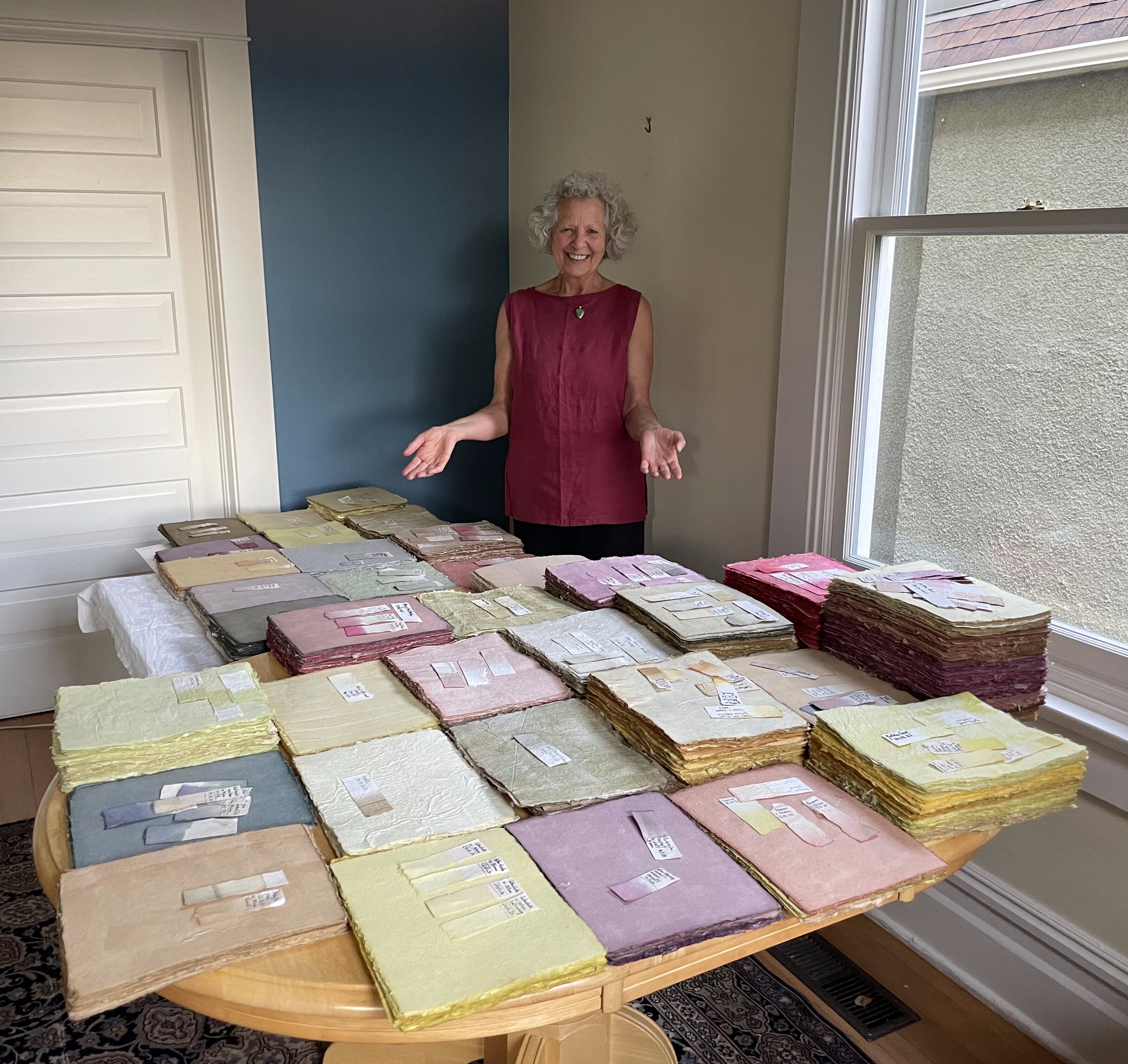
Brigitte Potter-Mael: In 2019, which was the 100th anniversary of Rosa’s death, GEDOK gave me a solo show to comment on Rosa Luxemburg. I brought my scrolls because she was a botanist before she became a Marxist theorist. I created a work called “Plant Murmurs” over four years—over 3,000 pages of handmade paper that I made and hand-dyed with inks from foraged plants. It’s a five-foot stack that represents Rosa Luxemburg’s height.
The work is still in my hands, and the Rosa Luxemburg Institute in Berlin is very interested in acquiring it, but they don’t have the funds. Deep inside, I want this work to go there. I think that’s where it should go. The real price for insurance would be $100,000, but I would sell it to them for $20,000. I’m 82 now, so at some point I need to begin to do my archives. I want specific works to have a home so when I go, I can feel that my children are taken care of.
Elke Porter: You have several exciting things coming up!
Brigitte Potter-Mael: Yes! On April 8th, I’m opening a solo show at the Dal Schindell Gallery at Regent College at UBC campus through May 27th. I will do a retrospective of 25 years, but only work that has to do with language—my alphabet work, my word weavings, the PlantMurmurs piece, and recent work called PlantWisdoms.
For my PlantWisdoms series: these are partially borrowed plant specimens from Beaty Biodiversity Museum, as well as UBC Garry Oak Meadow and my own garden. I created my own technique from wooden plates that I call “woodcut intaglio”—I’m carving but doing it as though it was an etching. I’m inserting positive concepts that we need in this time of turmoil—resilience, perseverance, hope, generosity—all in my alphabet. The plant and language are coming together, and I’m very happy about that.
Elke Porter: And you were nominated for a public art project?
Brigitte Potter-Mael: Yes! I was nominated for a public art call in May called “The Teachers Among Us.” The project is called “Tapestry for Coexistence.” I’m creating a print that involves 15 language bits from 15 different languages from students at the Mosaic Language Learning Center. It’s all about greetings—hello, how are you, how you doing—because it’s about how we make connection when we come to a new place. They accepted it, and I’ll be showing this work in 10 different bus shelters in Vancouver, probably mounted in August next year.
Elke Porter: You’re also part of the Eastside Culture Crawl!
Brigitte Potter-Mael: Yes! The Culture Crawl is from November 20th to 23rd. I’m at 1000 Parker Street, Studio 218. The crawl has been so good for me because I love to talk about my work. I’m also collecting thousands of leaves for my tapestry project—it’s my daily practice. I did a workshop with Mount Pleasant Neighbourhood House with 55-plus seniors called “Collective Mandala.” The feedback was so beautiful—they said it was such a healing workshop because it’s tactile, it’s about touching nature.
Elke Porter: Can you walk us through your creative process?
Brigitte Potter-Mael: I have to figure everything out in my head first. I’m not someone who sits down and sketches. I envision everything. I will read, contemplate, and in printmaking especially, I will do a lot of trial and error. I contemplate a lot. I sit with things for a long time. It could take a year, or even four years for work to mature. The work does itself after a while—it continues because it needs to be done, even though you don’t have the full picture at the time. It tells you what it wants to be.
With this collecting of leaves, I don’t know where it’s going to lead me. I just know I have to do it. It’s like turning the soil of your garden and putting the compost in and just tending it, and then it will show you what it wants to be and whether it’s fruitful.
Elke Porter: Is there anyone in your family who was involved in art?
Brigitte Potter-Mael: Yes, my grandfather on my mother’s side was a painter. My father was killed in a Messerschmitt plane crash at age 23, not in battle, and my mom was pregnant with me for seven months, so I nearly didn’t make it. My mother had two sisters, and one of them had two sons who became orphans because both their parents died. They are also both painters. So the three of us are artists, working artists—one in Berlin and the other in Detmold in Northern Germany. We are in touch through WhatsApp to keep my language going.
Elke Porter: What does success look like for you at this stage of your practice?
Brigitte Potter-Mael: I’m already looking three years ahead, or ten years ahead, in terms of consolidating what I want to call the core work and beginning to get proactive on where that work has to go. If it ends up in the places that I would like them to be housed in, whether I’m giving them as a present, as a donation, or whether it’s going to be acquired, that would be success. It has never been about money for me. I have never been hungry, nor have I been without a roof. I feel blessed that I can do my work and that I’m at peace with it.
Success is to be able to continue doing good work. What is good today may not be as good as what follows—we don’t know. That’s for the public to say. The public has to say whether it’s good work or not. But there are pieces that still stand up from 1983. I just got an email from Montreal asking me to release the use of a work for a TV episode filming. It’s a lithograph I did in my last year at university, and it’s being shown in a senior artist’s house. Things work for me organically—just putting it out there, believing in it, and just doing the work.
Elke Porter: What has been the most surprising response you’ve had to your work?
Brigitte Potter-Mael: Recently, when I submitted my proposal for “Tapestry for Coexistence,” I mentioned I may insert some of my oak leaf alphabet writing. One of the jury members questioned whether this was appropriate because it looked like the runes that the right-wingers are now appropriating. Unbelievable! I cannot believe it! How can you even make that connection when I’m talking about generosity and all of that?
So then I thought, okay, I’m just going to embed a little word here and there in the leaves of the botany. Then I decided to just put a little word such as “peace, coexistence, interconnectedness, etc.” This would hopefully put the jury at ease!
Elke Porter: Thank you so much for sharing your story, Brigitte!
Brigitte Potter-Mael: Thank you, Elke! This has been wonderful.
Visit Brigitte Potter-Mael at the Eastside Culture Crawl:
- When: November 20-23, 2025
- Where: 1000 Parker Street, Studio 218, Vancouver
- Hours: Thursday & Friday evenings (5-10pm), Saturday & Sunday (11am-6pm)
Upcoming Exhibition:
- What: 25-Year Retrospective of Language-Based Work
- When: April 8 – May 27, 2026
- Where: Dal Schindell Gallery, Regent College, UBC Campus
Dal Schindell Galleryhttps://www.schindellgallery.ca
5800 University Blvd. Vancouver, B.C.. Canada V6T 2E4.
Learn more about Brigitte’s work at her website (https://www.brigittepottermael.com/) or visit the Malaspina Printmakers Society on Granville Island.
TAGS:
#EastsideCultureCrawl #VancouverArtist #GermanCanadianArtist #BotanicalArt #ContemporaryPrintmaking #NatureAndLanguage #WestcoastGermanNews #ElkePorter
©Penelope Edgar – Photo Credit given to https://www.instagram.com/penelope.edgar
About The Author