
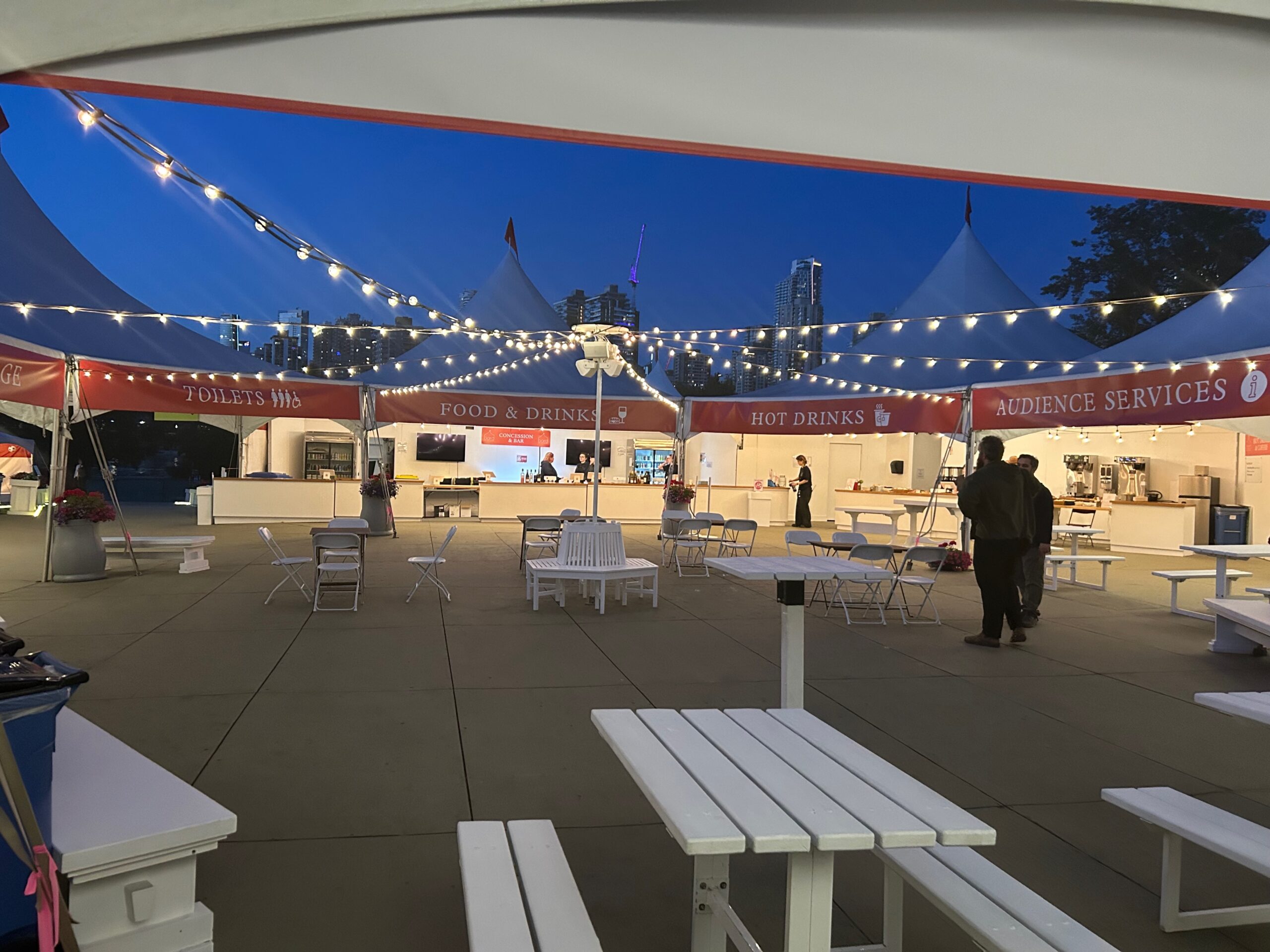
If you like your Shakespeare dark, dystopian, and delivered with sledgehammer intensity, then Stephen Drover’s adaptation of Macbeth, now playing on the BMO Mainstage at Bard on the Beach, is absolutely your production. If, like me, you prefer to leave the theatre laughing, you will still find yourself riveted — and caught up in the blood and gore and darkness that jumps out at the audience from the beginning to end.
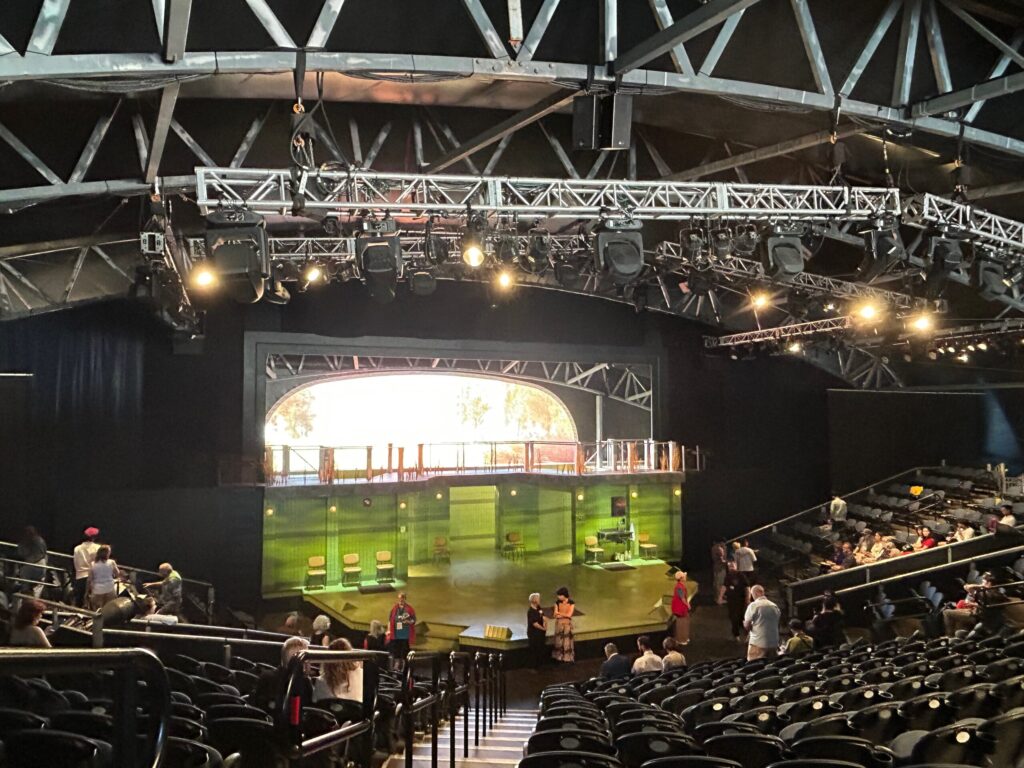
The assault on the senses begins before a single actor sets foot on stage. Eerie, jarring music fills the tent as the audience settles in, immediately signalling that what follows will be no ordinary evening at the theatre. That music — Don Hayley’s unsettling composition “I Love Evil” — was described by Composer and Sound Designer Mary Jane Coomber as something that “grabbed my focus immediately and quickly became an obsession, and eventually a necessary addition to the sound design.” It shows. The sonic landscape of this production is as much a character as Macbeth himself, wrapping the audience in unease from the very first note.
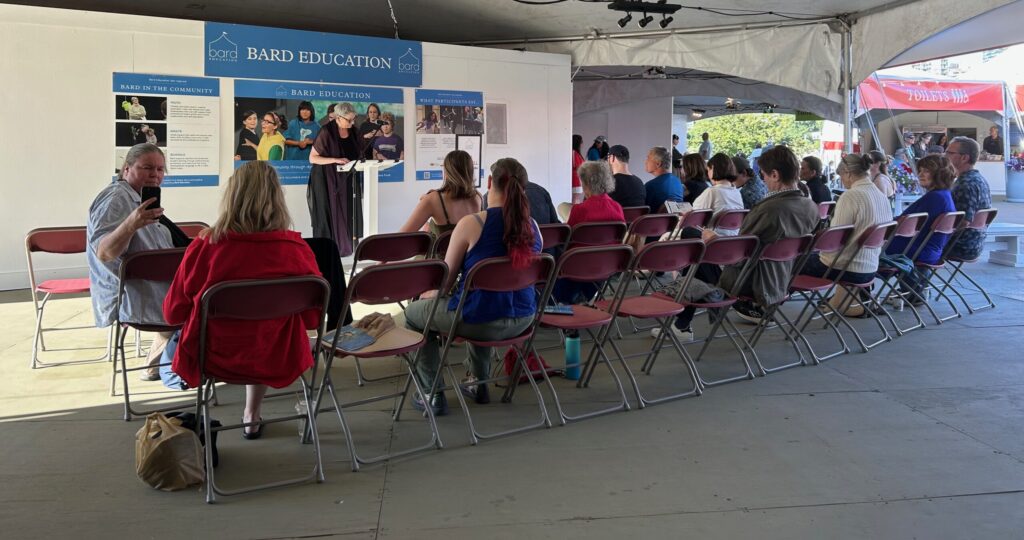
The evening began even before curtain with an illuminating pre-show session led by Director of Education Mary Hartman, who immediately reframed expectations. We tend to hear the word “witches” and picture women circling a cauldron, chanting and tossing in eye of newt. Drover challenges that assumption entirely. In this production, the three opening figures are otherworldly creatures — androgynous, unsettling, draped in black netting and strips of plastic string. They lift their masks to reveal painted faces and speak in voices that seem to come from somewhere beyond human. They are not witches in any traditional sense. They are something harder to name, and therefore far more frightening.
When they later rose through trapdoors built into the stage floor, wreathed in dry ice and eerie lighting, the effect was genuinely spine-tingling. It was the kind of theatrical moment that reminds you why live performance cannot be replicated on a screen.
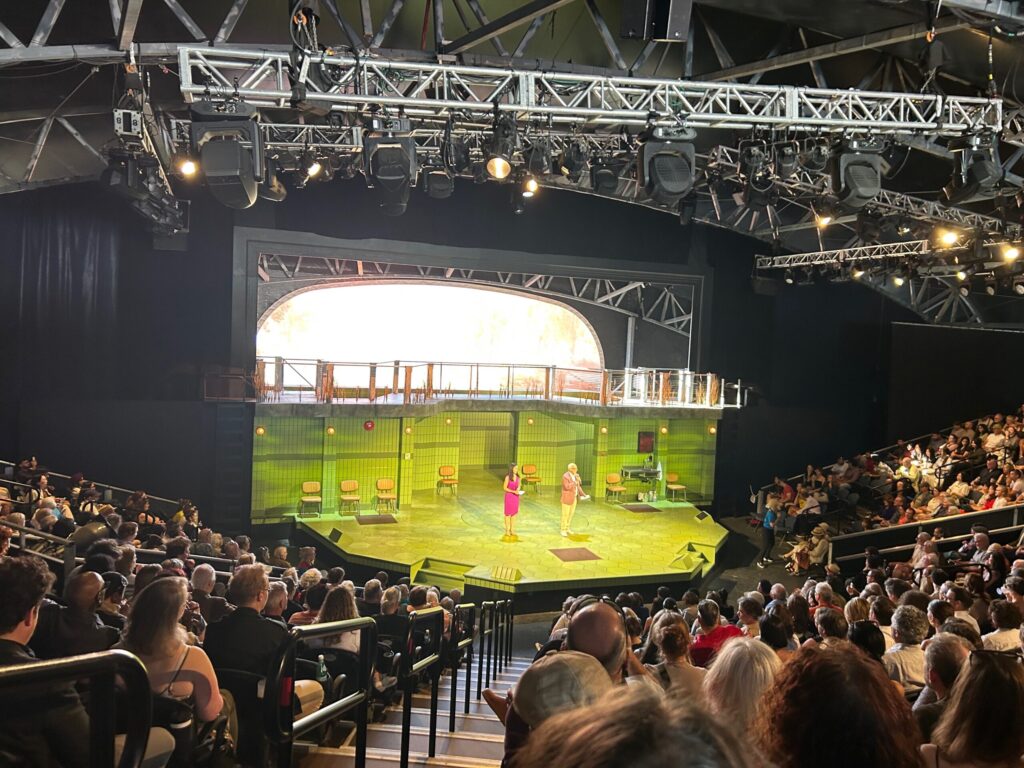
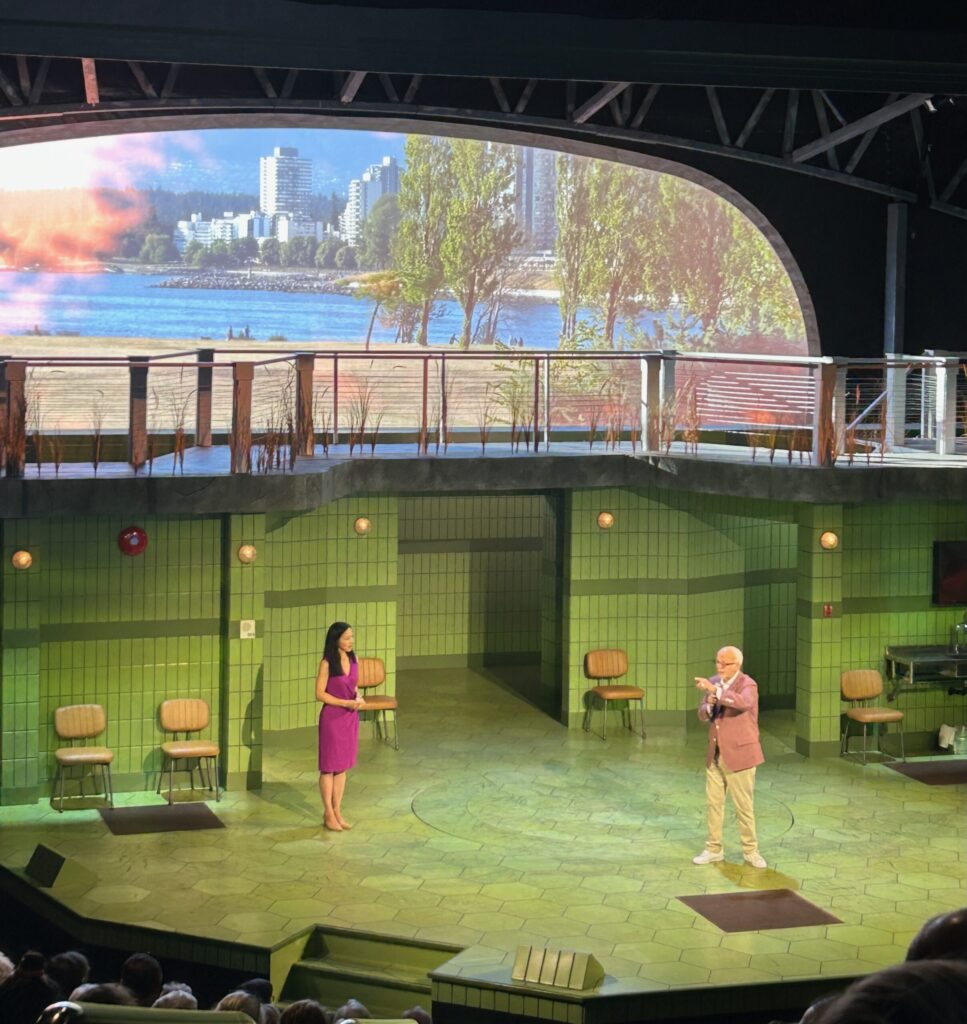
Drover, who holds an MFA in Directing from UBC and an MA in Theatre Theory and Dramaturgy, and has published research on Shakespeare adaptation in the Shakespeare Bulletin, has made no attempt to soften the play. His stated vision — to treat Shakespeare as a collaborator rather than a proprietor — is evident in every scene. This Macbeth is set in a harsh post-urban dystopia, the result of some unspecified catastrophic event that has driven the Macbeths to dwell in a sealed underground bunker. Set Designer Amir Ofek drew inspiration from tiled medicinal slaughterhouses, abandoned indoor swimming pools, and public shower rooms to create what he describes as a spotless underground tiled maze — the domain of a cleanliness-obsessed Lady Macbeth. The upper mezzanine, by contrast, represents the contaminated outdoor world above.
What makes this particularly delicious is the irony of the real backdrop behind the stage: a breathtaking, ever-changing panorama of ocean, mountains, the West End skyline, and a glowing sunset, with cyclists, pedestrians, boats, and distant cars in constant motion. The contaminated fictional world and Vancouver’s extraordinary natural beauty exist in the same frame simultaneously. The design itself is minimal — and that minimalism is precisely the point. A spotless tiled bunker is all they need to convey murderous times in their full gory glory, while keeping some of the most violent action deliberately off-stage, heard but not seen, leaving the imagination to do its darkest work.
Munish Sharma commands the stage as Macbeth with ferocious commitment. His portrayal of a man unravelling under the weight of his own ambition is visceral and compelling — you cannot look away even when you want to. Tess Degenstein as Lady Macbeth is equally magnetic, a steely, calculating presence whose own psychological collapse is rendered with quiet devastation. Her sleepwalking scene — in which she scrubs obsessively at an actual spot on the floor, haunted by blood only she can see — is among the most chilling moments of the evening.
But it was the infamous dinner party scene that made me and other members of the audience laugh out loud. Macbeth, hosting a royal feast and slowly coming undone by the ghost of the murdered Banquo, unleashes a torrent of defiance at his invisible tormentor — challenging it to take the shape of a bear, a rhinoceros, a tiger, anything but that — before the vision finally retreats and he turns to his bewildered guests, attempting to collect himself. “Pray you, sit still,” he implores. The audience, who had watched chairs being shoved and guests leaping in alarm, weren’t sure where this was going. Then Lady Macbeth stepped forward and paused. Just long enough.
Then delivered: “You have displaced the mirth!” and then stopped talking before she delivered the rest of the line.



That pause was a masterclass in comedic timing — it broke the ice, released the tension, and brought the entire house together in laughter. In the middle of Shakespeare’s darkest tragedy, Tess Degenstein found the perfect beat, and the audience loved her for it.



The play does not relent. The slaughter of Macduff’s family lands with quiet, brutal devastation. But the final confrontation between Macduff and Macbeth is perhaps the most psychologically complex moment of the entire production. Macbeth, having already destroyed everything Macduff loved, is oddly reluctant to fight — not out of remorse, but out of a twisted certainty that killing one more man would simply add to his already unbearable guilt.

His confidence evaporates entirely when Macduff reveals he was not, strictly speaking, born of woman — ripped prematurely from his mother’s womb, he falls outside the protection of the prophecy Macbeth had staked everything on. Suddenly, the tyrant is afraid. It is only when Macduff threatens to parade him as a public spectacle that Macbeth’s pride forces his hand. He fights. He loses. Macduff kills him, cuts off his head, and presents it to Malcolm, who is proclaimed king and rewards those who remained loyal. The cycle of power, violence, and survival grinds on.

Bard on the Beach runs through September 19, 2026 at Sen̓áḵw/Vanier Park. Macbeth is not everyone’s cup of tea. But it is done with passion, intelligence, ferocious skill, and an intensity that holds you from the first jarring notes of pre-show music to the very last drop of stage blood. Drover’s invitation stands: walk beside your fears for an evening. You may just come out the other side with a sense of peace. Book tickets at bardonthebeach.org.